
KMA Bunny logo
About KMA
Contact Us
Directions
Lessons
Meetings & Shoots
Membership
Our Range
Archery Links
Archery Tips
Bow Tuning
Equipment Selection
Shooting
Calendar
Current Newsletter
For Sale
Join Us!
Application Form (PDF)
Member-only Area
Vertical bar

Making Sense of Steep Angle Shots

Based on the works of Tom Henderson, Steve Mansour, Perry Ratcliff, and Thomas L. Liston.
Edited by Steve Russell

Quick Explanation

The most common rule about uphill/downhill shots is that you shoot for the horizontal component of the range to the target.

For example, if you were shooting a 40 yard uphill shot at a 30 degree angle you would set your sights for about 35 yards (the cosine of the 30 degree angle times the line-of-sight distance to the target - which in this instance comes out to 0.866 times 40 yards = 34.6 yards). This would represent the actual horizontal range to the target and is a pretty good starting point.

For distances from about 20 to 40 yards this works pretty well depending on a variety of factors such as bow speed and arrow size, weight, and drag.

For shorter distances, less than about 20 yards, you run in to increasing parallax errors with either sights or your basic eyeball. For distances longer than about 40 yards you begin to feel more of the effects of drag.

You can take the above and apply it in practice to see how well it works for you.

As stated, it is dependent on several factors so your mileage may vary. Of course, you're going to say, "How can I tell at what angle the shot is?", and the reply has to be get a protractor, electronic level, or simply measure the horizontal and vertical components to a known distance angle shot and try it out.

This is the simple explanation.

However, if you're into it we invite you to follow along on a more involved discussion of the problem.

Of the two major factors affecting arrow flight - drag and gravity - certainly the easiest to work with is gravity.

We'll reserve the discussion on drag for another time and focus on the effects of gravity starting with the concept of a free-falling object.

Free Fall

A free-falling object is one whose downward acceleration is caused by the force of gravity alone. Earth exerts an acceleration of about -10m/s/s (actually -9.8 meters per second per second or -9.8m/s2). An object held at rest and then released will accelerate downwards at about -10m/s2 for every second it is falling. An object thrown or shot from cannon or bow will accelerate downwards at the same rate - it will just go horizontally while it is also accelerating downwards at -10m/s2.

Since this site deals with ranges in feet (and yards) we'll use the actual acceleration of -9.8m/s2 and convert it to feet so that the effect of gravity will be represented as an acceleration of -32 f/s2 (well, actually -32.152 feet/second2 but we'll round things off for convenience).

The Effect Of Gravity

With the Earth exerting a pull of -32 f/s2 that means that an object starting at a stationary location and then released in free fall will accelerate to and be traveling at -32 f/s after the first second, -64 f/s after the second, -96 f/s after the third, and so on. It doesn't matter if the object has a horizontal velocity or not: it still falls, or accelerates, at -32 f/s2.

When shot from a bow an arrow is accelerated to its maximum speed and then continues on it's own inertia. Without the effects of drag or gravity it would continue along it's initial path forever or until it hits something.

However, just as in our stationary object above, our arrow feels the same gravitational effect and falls at the same rate of -32 feet/second2.

Projectile Model

At launch our arrow becomes a simple projectile - we accelerate it to a constant speed, launch it at a given angle, and then it travels in a parabolic path to the target. The only force acting on our arrow in flight (ignoring drag) is the acceleration of gravity which we know to be a constant -32 feet/second2.

Using kinematic equations (learned and forgotten in high school) we can solve simple projectile motion problems involving arrow flight. (Kids - stay in school: you will use that information at some time in your life!)

Calculating Arrow Path - Level Shot

The effect of gravity is only felt after some duration of time. We'll need to work with a shot model that lets gravity have a chance to modify our flight profile measurably so lets look at a horizontal shot of 40 yards.

We know the distance involved and the acceleration of gravity. The last element needed is the speed of the arrow.

Our test case will be as follows: An arrow is shot parallel to the ground at a target 40 yards away. Starting at a shooting height of four feet above the ground our bow gives the arrow an initial velocity of 240 feet per second (240 fps). The initial course is shown as the blue dashed line leading towards the target spot four feet above the ground. Gravity will begin pulling it off this course the instant it leaves the bowstring and is represented by the red line shown below.

The question is; how much will gravity pull the arrow down before it strikes the target?
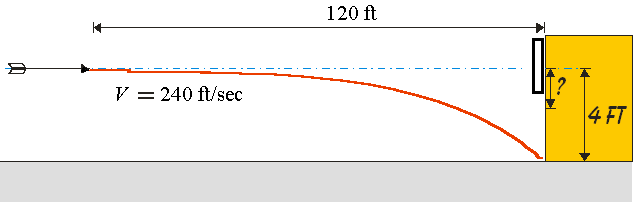
Since the arrow is shot parallel to the ground, or at zero degrees to the horizontal plane of arrow flight, there is no initial vertical velocity and all of its horizontal velocity is applied to covering horizontal distance. So, to determine how long it should take for the arrow to hit the target is straightforward - we divide the range to the target by the speed of the arrow, or:

Now that we know how long the arrow is in flight, we can determine how much it will drop. An equation describing the vertical location of a projectile in motion is:

where y0 is the initial height, in this case 4 feet; vy0 is the initial velocity in the y (vertical) direction, in this case 0 since all the initial velocity was horizontal; and ay is the acceleration in the y direction, in this case the only acceleration is gravity at -32 f/s2; and t is the point in time where we want to know the position, in this case 0.5 sec. Plugging in these values the equation becomes:

This result shows that gravity will pull the arrow down about 4 feet causing the shot to strike the target low at the base of the bale where it meets the ground. If the arrow is aimed 4 feet above the bulls eye then it should strike the bulls eye.

When setting pin sights this is exactly what would be done - the pin would be adjusted to chase the arrow impact point until the pin and arrow both show the same impact point after launch. This way we eliminate any messy calculations and just shoot the pin for the correct distance based on trial and correction of error.

For this particular example the corrected launch angle is just about +2 degrees (+1.91 degrees) above horizontal from the arrow's point of view. This is calculated by taking the arcsin of the drop divided by the range. That would be arcsin(4 feet/120 feet) or +1.91 degrees. Note that the graphic below is an extreme exaggeration and not to scale in order to illustrate this point.

What if the bow was shooting at 250 fps? 310 fps? Plugging 250 fps into the above calculation produces a drop of about 3.68 feet. At 310 fps the drop is only 2.39 feet.

The faster the arrow, the shorter the arrow flight and therefore gravity will have less time to affect the drop height. This explains the push for faster cams and lighter arrows.

As the horizontal range increases or decreases our non-drag flight model always stays the same - a parabola with the arrow going up, peaking along the way to the target, and then falling an equal amount until it reaches the target.

Steep Angle Shots

We can see that gravity can have a significant effect on our arrow path. A long shot with even a fast bow has enough drop to miss the bulls eye or the entire bale.

Now lets see what happens when the shot has an extremely steep angle involved.

Consider the following archery scenarios.

(a) Uphill Shot

(b) Downhill Shot

In the case of the Uphill Shot (a), what distance should the shooter use? Many archers give answers like "since it's uphill, just a little over 20 yards" while others give the answer "just a little under 20 yards". The correct answer is 10 yards. Even though the target is a full 20 yards away, the effect of gravity only acts during the horizontal travel component of the arrow. Now, for the tricky one: what distance should the shooter in the tree stand use? The answer is 7 ft. Again, gravity only affects the arrow over its horizontal travel of 7 feet. Most bows shoot fast enough so that there is negligible difference between a 7 ft shot and a 21 ft shot. But if we changed the distances in a downhill shot to a total distance of 210 feet (70 yards) and a horizontal distance of 70 ft (23 yards), the archers who aim this shot a little over or under 70 yards will not only miss, but probably end up losing an arrow.

The curious point, and the one that is counter-intuitive to many people, is this: no matter whether you are shooting uphill, downhill, or level, correct for gravity based on the horizontal distance between you and the target.

Calculating Arrow Path - Angle Shot

Using the same bow and arrow combination lets apply the same performance values to a 30 degree up hill shot.

Our flight path will still be the parabolic model we developed above but now we'll have arrow impact on the slope of the parabola rather than at the same elevation of the launch point.

In the horizontal shot we modeled above we found we needed to add about 2 degrees to the launch angle to compensate for arrow drop over the 120 foot flight path. What happens if we make that a 30 degree uphill shot at the same distance using the same 40 yard pin setting? To properly calculate the impact point we must use both horizontal and vertical components of the arrow flight instead of just the horizontal component. This sounds really involved - and it is - but we'll try to show it in a manner that justifies the original assertion that you simply aim for the horizontal component of the range and let fly.

Way (waaay) back in high school we learned about right triangles and how to figure out the length of the sides and degrees of angles.

Here we have a diagram of an uphill shot at 30 degrees from horizontal. We have a known range to the target of 120 feet and we've given the angle of 30 degrees. From this we can figure both the elevation and horizontal distance to the target using standard trigonomic functions.

The cosine of 30 degrees is 0.866 so our horizontal distance to the target is COS30(120) or 0.866 x 120 = 103.9 feet.

The sine of 30 degrees is 0.5 so the elevation from our shooting position to the target is SIN30(120) or 0.5 x 120 = 60 feet.

Our arrow must not only travel 60 feet higher than one shot horizontally but the horizontal component of flight will only be 103.9 feet instead of 120 feet. Likewise, we now have significant changes to the horizontal and vertical arrow speed components to contend with.

What will our arrow flight be if we launch using our 40 yard pin which was set up using a horizontal 40 yard target? (this will be the result of the original horizontal correction of +2 degrees combined with the additional +30 degree uphill angle.

The following diagram illustrates this.

That tiny blue line on the left side of the diagram is the arrow path. Our arrow will impact the target during the upslope portion of the flight path instead of at the end of the parabola. Note the potential maximum range for this angle launch - which is why high-draws are not recommended at any range.

Using our fixed 40 yard pin setting (with our new launch angle of 32 degrees) we can calculate the values needed to provide our answers.

The 32 degree launch angle changes both the horizontal and vertical velocities which use the same sine and cosine functions to determine their new values.

The initial vertical velocity is SIN32 x 240 fps = 0.5299 x 240 = 127.18 fps.

The initial horizontal velocity is COS32 x 240 fps = 0.848 x 240 = 203.53 fps.

The time of flight is the true horizontal distance of 103.9 feet divided by the true horizontal arrow speed of 203.53 fps or 0.51 seconds. This is 1/100th of a second slower than our horizontal shot.

With these figures we should be able to determine where our arrow is vertically at what should be the point of impact. Our original formula,

becomes

which shows us that using our 40 yard pin at a 30 degree uphill shot will put the arrow at 64.71 feet above the launch point or 0.7 feet above the spot instead of in the spot which is, of course, not a good thing.

With our 40 yard pin sitting 0.7 feet below the spot your site image should look pretty much like you're splitting the 30 and 40 yard pins (pin shooters) or simply anchor 0.7 feet below the spot which would put your actual pin setting somewhere around - oh gosh - 35 yards, which is what we started out to demonstrate at the beginning of this article (aren't you glad that's over with?).

What About the Downhill Shot? (arggg!!!)

What changes when the shot is downhill or is there a real difference?

Using our same model - inverted - we can take a quick look. If you'll excuse my laziness lets exclude the pictures and just deal with the formulas and see what pops out quickly.

The equations describing the trajectory of the downhill shot are the same as those of the uphill shot, only the angle changes - its down now - and the sign of the initial vertical vector changes.

Our line of flight is at 120 feet, horizontal distance 103.9 feet, vertical drop -60 feet, and arrow speed of 240 fps.

Our launch angle is now -28 degrees (that is 30 degrees down and then add the +2 degrees for our fixed 40 yard pin setting). The 40 yard pin setting gives us the following values:

COS30 x 120 ft = 0.866 x 120 = 103.9 horizontal feet to target

SIN30 x 120 ft = 0.5 x 120 = -60 vertical feet to target

COS28 x 240 fps = 211.907 horizontal fps at launch angle

SIN28 x 240 fps = -112.673 - vertical fps at launch angle

With the above information we find that our time to impact is 103.9 ft divided by 211.907 fps or 0.4903 second. We gained arrow speed because we're shooting downhill with an initial negative vertical vector. Our downhill arrow speed is more than 8 fps faster than our uphill speed.

Back to our formula,

Our vertical position at impact will be the launch height + position at time "t" + one-half the acceleration of gravity times "t2" or,

4 + (-112.673fps)(0.4903s) + 0.5(-32fps2)(0.4903s)2

4 + ( -55.2435f) + 0.5 (-32fps)(0.2404s)

-51.2435 + 0.5 (-7.6928) = -51.2435 + (-3.846) = -55.089 feet

With the target sitting at -56 feet (-60 feet down hill + 4 spot height) we'll be high 0.92 feet.

From this you can see that downhill shots let our arrows be just a little bit faster so we must compensate for this by dropping our aiming point just a little more compared to the equivalent uphill shot.

Pin Gap

As the distance increases you'll see the pin gap slowly widen between adjacent pins. The gap between the 50 and 60 yard pin may end up being almost twice the gap between the 20 and 30 yard pin. What you're seeing is the effect of flight time on the shot arrow. In our test example above we shot an arrow traveling 240 feet per second at a target 120 feet away for a flight time of 0.5 second. The horizontal arrow drop was 4 feet. If we shoot that same arrow at an 80 yard target the flight time will be 1.0 second with a corresponding drop of 16 feet! From this we see most clearly that the more time the arrow is in flight, the faster it drops in the horizontal plane.

Get All The Angles

There are a number of ways to get the angle of the shot. You could haul around an inclinometer and, although bulky, it will work.  You might be happier with a digital electronic level which are available for less than $100 at a construction tool outlet such as OSH.

You can even estimate the angle based on various bow landmarks at full extension (a familiar device for all you 3-D shooters out there). Simply knowing that at full horizontal extension the top of your bottom cam is about 35 degrees down will give you a starting point.

A simple $5.00 calculator with scientific functions will do the rest.

Drag

I know. I said I wasn't going to talk about drag - very much, anyway. However, any discussion of arrow flight would not be complete without some mention of arrow drag and the effect it has on flight.

If you'll revisit our theoretical 1621 foot arrow shot above, the one thing not considered is drag and it will have a significant effect on the maximum distance the arrow will achieve.

Without going into detail about all the factors that determine the amount of drag on the arrow body (such as shaft diameter, shaft length, size of fletching, type of fletching, total weight, and point profile) the statement can be made that in general the longer the arrow is in flight the lower it's terminal velocity at impact and the further it drops. Varying any of the drag factors will affect the amount of drag.

Using the Arrow Ballistic Table calculator from www.bowjackson.com we're able to determine the additional arrow drop due to drag caused by adding arrow weight. A 500 grain arrow launched at a 40 yard target actually drops almost 4.3 feet - 4 feet from gravity and the additional 0.3 feet from drag. That same physically sized arrow but weighting only 400 grains drops the same amount. A 300 grain arrow launched at the same speed actually falls a little farther. These three arrows shot at an 80 yard target result in an 18.5 foot drop at 500 grains, 19 foot drop at 400 grains, and 20 foot drop at 300 grains.

This may seem strange until you consider that the amount of kinetic energy in the heavier arrow is greater than that in the lighter arrows - when launched at the same speed. The 500 grain arrow has nearly twice the kinetic energy than the 300 grain arrow launched at the same speed.

This is something to consider when choosing your bow and arrow combination.  You'd actually want a combination that places the maximum amount of kinetic energy into the arrow to flatten the trajectory and tighten your groups.

So now I know it all?

Well, now you know why uphill/downhill shots are different from horizontal shots and each other. We've got a good start but you've seen having the horizontal distance to the spot is only part of the equation. Factors such as arrow speed and drag also play an important part.

How much you take off for uphill and downhill shots is still very much a matter of experience and changes with the equipment. That means getting out on the range and practicing whenever you can. The discussion above has given you a solid background in what effects take place during the uphill and downhill shot sequence and is a good starting point to hone your archery skills.

Or you could indulge yourself with the technology available today.  Perry Ratcliff discusses a software program available for PDA to calculate the correct yardage based on arrow speed, angle, and drag. Visit the web site, www.archersadvantage.com for more information and Perry's explanation of up hill/down hill shots.

Keep practicing. Take notes.


[an error occurred while processing this directive]